Blog

  • The Voyage

    Life Between Two Worlds

    Once the shoreline disappeared, families entered a world unlike anything they had known. They were no longer part of the Old World, but they had not yet reached the New World. They were suspended between past and future, between memory and possibility, between everything familiar and everything unknown.

    That middle place must have felt strange to the human heart. Behind them was a life they could no longer easily return to. Ahead of them was a future they could not yet see. Around them was water, wind, wood, rope, sky, and the constant motion of the sea. There was no road back, no village in sight, no familiar church bell, no known field, no doorway to return through.

    The ocean became more than distance.

    It became the space between who they had been and who they were trying to become.

    Below Deck

    For many passengers, life below deck was crowded, dark, damp, and difficult. Wooden quarters were cramped. Fresh air was limited. Privacy was almost impossible. Sickness could spread quickly. The smell of saltwater, sweat, fear, illness, damp clothing, stored food, and humanity filled the space where families tried to sleep, pray, comfort one another, and survive.

    The journey was not romantic. It was hard.

    People who had already left behind nearly everything familiar now had to endure weeks of discomfort and fear. A ship could carry hope, but it could also become a place of exhaustion. The body had little room to rest. The mind had little room to escape. The sea moved beneath them even when they tried to sleep.

    Families had to create some kind of order inside disorder. They guarded their small bundles, kept children close, watched the sick, saved what food they could, and tried to preserve dignity where comfort was scarce.

    The smallest things mattered: a dry corner, a shared blanket, a cup of water, a quiet prayer, a familiar voice in the dark.

    On land, people had known where they stood.

    At sea, even the floor beneath them moved.

    The Atlantic Ocean

    The Atlantic reminded people how small human beings can be. Storms terrified passengers. Waves rose higher than anything many had ever seen. Violent winds shook everything that had seemed stable. For weeks, there could be no land in sight, only water, sky, and the awareness that nature could not be reasoned with.

    The same ocean that carried their hope also held their fear.

    In calm weather, the sea may have looked endless and almost beautiful, but even that beauty could feel lonely. In violent weather, it became a force beyond human control. The ship that had seemed large at the harbor could feel small against the Atlantic.

    There is something humbling about open water. It strips away the illusion that human beings control everything.

    People who had already surrendered home now had to surrender certainty. They could not command the wind, hurry the horizon closer, or make the waves obey. They could only endure the day in front of them, then the next day, then the next, while hope remained somewhere beyond sight.

    Families Under Pressure

    Families were tested in every way. Children were frightened. Parents were exhausted. Food and water had to be guarded carefully. The sick needed care. The weak needed help. People who had once been strangers became temporary communities because survival required more than individual strength.

    Hardship forced people to lean on one another.

    A mother might comfort a child while hiding her own fear. A father might pretend confidence he did not feel. A stranger might share water, lift a bundle, steady someone during rough seas, or sit beside the sick when there was little else to offer.

    In such conditions, small acts became large.

    Kindness could become courage. Patience could become strength. A hand held in darkness could remind someone that they were not alone.

    History often remembers ships, dates, routes, and arrivals. But the real crossing happened inside ordinary people. It happened inside the parent trying to keep a child calm, the exhausted passenger helping someone weaker, and the frightened soul who kept praying when no answer seemed visible.

    The voyage did not only test bodies.

    It tested love, patience, faith, and the will to keep going.

    Faith And Grief At Sea

    For many, prayer became part of survival. People leaned on belief, family, and whoever stood beside them. Courage did not arrive all at once. It grew through hardship, one day at a time, one storm at a time, one act of care at a time.

    Hope survived even when fear was stronger.

    But not every story reached land. Disease, malnutrition, accidents, weakness, and the harshness of the crossing took lives along the way. Some families carried grief across the water. Some lost loved ones between the world they had left and the world they hoped to reach.

    Grief traveled beside hope.

    To remember the voyage honestly, we cannot make it only brave and beautiful. We must allow it to be painful, costly, and deeply human.

    The Ocean Changed Them

    The voyage changed those who survived it.

    Suffering creates resilience. Hardship changes perspective. People learn what truly matters when comfort disappears. They learn the value of a shared crust of bread, a whispered prayer, a steady hand, a cup of water, a protected child, and a stranger who chooses compassion when everyone is afraid.

    The people who reached the other side were not the same people who had stepped onto the ship. They had left one world, endured the ocean, and carried forward both hope and sorrow.

    That lesson belongs to more than one generation.

    Every life has crossings. Every family, every people, and every nation eventually faces a stretch where the past is gone and the future has not yet arrived. The voyage reminds us that the middle can be the hardest place to remain faithful.

    It is where hope must survive without proof.

    It is where courage must continue without applause.

    Comfort can hide the strength previous generations needed simply to survive.

    We remember not to glorify suffering, but to honor those who endured it.

    Their voyage reminds us that civilization is not handed forward without cost. It is carried by people who suffer, adapt, help one another, and keep moving toward a hope they may not fully live to see.

    After the voyage came landfall. Exhausted settlers would finally see the New World, but arrival did not mean safety. The land they had dreamed of would test them in new ways.

    The ocean had carried them away from the world they knew.

    Now the land ahead would ask whether their hope could become a life.

  • Across The Atlantic

    The Final Decision

    The Final Decision

    There comes a moment when uncertainty becomes a decision.

    For many families, that moment must have been almost unbearable. Should they stay where life was known but limited, or leave for a future no one could promise? The choice was not made with comfort, certainty, or romance. It was made under pressure, in fear, in prayer, in argument, in silence, and in hope.

    To stay meant remaining inside the world they understood: familiar roads, familiar faces, familiar graves, familiar customs, and familiar limits. To leave meant stepping away from all of it. If they stayed, they might wonder what life could have been. If they left, they might lose everything and never return.

    Selling One Life To Chase Another

    To leave meant reducing one life in order to reach for another.

    Possessions were narrowed down to what could be carried. Homes were left behind. Tools, blankets, clothing, family objects, and small reminders of the old life had to be chosen carefully. Some things were sold. Some were given away. Some were abandoned because there was simply no room.

    That kind of leaving reaches deeper than travel. People were not merely packing for a journey. They were deciding what parts of their former life could survive the crossing. A cooking pot might represent a mother’s care. A tool might represent a father’s labor. A Bible, prayer book, letter, or family token might carry memory itself.

    They were not just bringing supplies.

    They were carrying proof that they had belonged somewhere before they stepped into the unknown.

    The Walk To The Harbor

    The walk to the harbor must have felt like walking between two lives.

    Behind them was everything known. Ahead of them was water, distance, danger, and possibility. Crowded docks, creaking wagons, crying children, shouted instructions, whispered prayers, final embraces, and long silences filled the air. Everyone standing there was caught between terror and hope.

    A harbor is usually full of motion, but for families leaving forever, every sound would have carried weight: the slap of water against wood, the smell of tar and rope, the groan of ships, the calls of sailors, the press of strangers, and the sight of the open sea.

    What had once been discussed around a table or whispered beside a fire now stood before them in wood, sail, water, and distance.

    The Last Look Back

    Before stepping aboard, many must have looked back.

    That last look may have held an entire lifetime: a street walked since childhood, a church bell heard for years, a parent too old to travel, a friend standing on shore, a grave that would never be visited again, a village, a field, a shop, a doorway, a corner of the world that had shaped them.

    Modern people can underestimate the pain of that moment because distance has become easier for us. We can cross oceans quickly. We can send messages instantly. We can see faces across the world. They could not.

    For many of them, leaving meant true separation. The ocean did not feel like an inconvenience.

    It felt like a wall.

    When the shoreline disappeared, part of their former life disappeared with it.

    Stepping Onto The Ships

    Then came the moment of no return.

    Feet stepped onto wooden decks. Hands held children close. Families found their places among strangers. Voices from shore began to fade. The shoreline slowly pulled away. What had been a debate inside the heart became reality before their eyes.

    The ships were not symbols to them. They were cramped, uncertain, dangerous vessels carrying human fear and human hope. The deck beneath their feet did not guarantee a future. It only carried them away from the past.

    Once the ship moved, the decision could no longer be undone.

    The old world was behind them.

    The new one was still only an idea somewhere beyond the horizon.

    Why They Still Went

    They went because hope can be stronger than fear.

    They believed opportunity might exist beyond what they had known. They believed freedom was worth risking everything for. They believed their children might inherit something better than what had been handed to them.

    They did not go because they were fearless.

    They went because hope refused to die.

    Courage is not the absence of fear. Courage often exists because fear is present. These people understood enough of the cost to tremble. They knew the ocean could take them. They knew sickness could spread. They knew hunger, storms, and death were possible.

    And still they went, because the future behind them felt too small, and the future ahead still held a chance.

    Human Courage Often Looks Ordinary

    History is not always moved forward by famous names. Often it is moved by ordinary mothers and fathers, ordinary workers, ordinary believers, and ordinary people making extraordinary choices.

    Their courage did not always look dramatic. Sometimes it looked like carrying a child, holding a spouse’s hand, standing quietly in line, lifting a trunk, wiping away tears, or stepping onto a ship while the heart was breaking.

    That kind of courage deserves remembrance because it built the human foundation beneath the larger story. Before there were colonies, declarations, battles, constitutions, presidents, or monuments, there were people willing to cross water for a future they would never fully see.

    Some would not survive. Some would suffer. Some would be disappointed by what they found.

    But their willingness to move toward possibility helped open the path later generations would inherit.

    Sacrifice becomes easier to honor when we understand it emotionally.

    Many freedoms were purchased through uncertainty, loss, and risk. Civilization moves forward because some people are willing to step into the unknown for the sake of those who come after them.

    After the decision came the crossing. The Atlantic would test the body, the mind, and the spirit. Storms, sickness, fear, endurance, and hope would all become part of the story.

    But before the voyage became an ordeal, it was first an act of human courage.

    They had already left the ground of one life behind.

    Now the sea would decide how much more the journey would demand.

    Continue the full REMEMBRANCE Journey

    This chapter is part of Remembrance: When Was the Last Time You Felt History? , a 57-chapter journey through the people, choices, sacrifices, and memories that helped shape America.

    The Kindle edition is available now. Paperback and hardcover editions release July 4, 2026.
    To view the book on Amazon. Click Here

  • The World They Left Behind

    Europe Before America

    Europe Before America

    Before America had a name, the people who would one day cross the ocean lived in a world shaped by limits. Much of Europe was built around inherited status, class systems, religious authority, land ownership, and traditions that often determined a person’s place in life before that person ever had a chance to prove themselves.

    For many ordinary people, opportunity was limited. A person could be hardworking, capable, and honest, yet still find the future narrowed by circumstances beyond his control. Birth, class, religion, and power often mattered more than effort.

    The Old World was not without beauty, faith, culture, and community. But for many families, it also held boundaries that seemed impossible to escape.

    Religious Conflict

    Religion was deeply woven into public life. In many places, government and church worked closely together, and those who disagreed with accepted religious authority could face punishment, exclusion, or persecution.

    For some, worshiping freely was not a right.

    It was a risk.

    The desire for religious freedom did not begin as a political principle. It began as a human longing. Parents wanted to raise children according to their conscience. Families wanted room to practice their faith without fear. Ordinary people wanted the freedom to follow what they believed was right.

    Long before religious liberty became part of the American story, it lived quietly in the hearts of people searching for room to breathe.

    Economic Hardship

    Life for many families was uncertain. Poverty, disease, overcrowding, poor harvests, and limited opportunity shaped daily existence. Many worked hard and still remained poor. Land was difficult to obtain. Independence often felt out of reach.

    For countless families, the future looked much like the past.

    Children expected to inherit the same struggles their parents had known. Opportunities seemed fixed. Advancement seemed distant. Survival often consumed the energy that might otherwise have been spent pursuing something more.

    The New World was dangerous, but danger can begin to look different when hope becomes scarce. When people feel trapped by circumstances they cannot change, even an uncertain possibility can begin to look like a doorway.

    Despite the differences in time, the people of that world were not so different from us.

    Parents wanted better lives for their children. Workers wanted dignity. Families wanted safety. Believers wanted freedom of conscience. Ordinary people wanted the chance to shape their own future.

    The clothes were different. The governments were different. The dangers were different.

    The human heart was not.

    People wanted to believe that tomorrow could be better than today.

    The Decision To Leave

    Leaving was one of the hardest decisions a person could make.

    It meant crossing an ocean filled with danger and uncertainty. It meant leaving behind family, friends, language, customs, familiar places, and often the graves of loved ones. For many, departure meant accepting that they might never return.

    Home is more than a place.

    It is memory.

    It is familiar voices, familiar roads, familiar seasons, and familiar faces.

    People did not leave because leaving was easy. They left because staying had become harder.

    Staying often meant accepting limits already chosen by birth, poverty, religious pressure, or political control. It meant watching children inherit the same barriers that had shaped previous generations.

    The risk ahead began to feel more hopeful than the certainty behind.

    What They Were Really Searching For

    The people who left were searching for more than land.

    They were searching for opportunity, self-determination, freedom of conscience, and ownership of their own future. They wanted the chance to build something larger than the circumstances they had inherited. Most of all, they wanted their children to have opportunities they themselves had never known.

    They did not know what America would become.

    They did not arrive with a perfect understanding of liberty, equality, or justice.

    They arrived as human beings.

    Flawed. Hopeful. Courageous. Uncertain.

    But they were already reaching toward an idea that would help shape the American story: that ordinary people should not be forever trapped by the circumstances of birth, class, power, or control.

    That idea would be challenged, expanded, corrected, and defended for generations.

    But its roots were already alive in the hearts of people willing to risk everything for the possibility of something better.

    We inherit freedoms many of us did not personally build. That makes remembering more important.

    The American story did not begin with comfort. It began with ordinary people willing to leave the only world they had ever known because they believed their children might inherit something better.

    From the world they left behind, the journey now moves toward the sea. The next chapter carries us onto the ships where hope, fear, courage, and uncertainty traveled together across the Atlantic.

    To understand the crossing, we must first understand the dream.

    It had to be powerful enough to make people leave everything behind.

    Continue the full REMEMBRANCE Journey

    This chapter is part of Remembrance: When Was the Last Time You Felt History? , a 57-chapter journey through the people, choices, sacrifices, and memories that helped shape America.

    The Kindle edition is available now. Paperback and hardcover editions release July 4, 2026.
    To view the book on Amazon. Click Here

  • Before America Had A Name

    The Search Before The Name

    Before America Had A Name

    The human desire for something better began before the nation did.

    The Search Before The Name

    Long before America had a name, human beings were searching for something better.

    They searched for freedom, opportunity, peace, survival, purpose, and a future they could pass on to their children. Across history, families have risked everything not because they knew exactly what waited ahead, but because they knew what life had become behind them.

    That desire is older than any flag, older than any constitution, and older than any nation.

    It lives in the heart of a parent who wants a safer life for a child. It lives in the worker who wants his labor to mean something. It lives in the family that looks at the future and realizes that staying where they are may cost more than leaving.

    Before America became a country, it first existed as longing.

    The Old World

    The world many people left behind was often rigid and unforgiving. Class systems shaped lives before people had much chance to shape themselves. Status was inherited. Opportunity was limited. Religious conflict divided communities. Ordinary people often lived under rules, rulers, customs, and expectations they had little power to change.

    For many, survival depended less on talent or character than on where they were born.

    A person could work hard and still remain trapped by birth, class, debt, landownership, religious pressure, or political power. Not every person who left Europe had the same reason, and not every story was simple. But again and again, people looked at the world around them and saw too little room to breathe.

    They did not all leave because they hated the place behind them.

    Many left because they loved the people in front of them.

    The Decision To Leave

    Leaving was not easy.

    It meant risk. It meant long ocean voyages, disease, uncertainty, separation, and the real possibility of never seeing home or family again. There were no guarantees. No promise of success. No certainty that the new world would be kinder than the old one.

    But for many, staying also came with a cost.

    Staying could mean remaining bound to a life already decided. Staying could mean watching children inherit the same limits. Staying could mean living under pressures that left little hope for change.

    So they left, carrying fear in one hand and hope in the other.

    That is one of the oldest human pictures in history: people stepping away from the known because the unknown still held a chance.

    The Kind Of People Who Came

    The people who came were not perfect people.

    They were courageous, desperate, hopeful, hardworking, deeply human, flawed, and determined. Some came by choice. Some came under pressure. Some came seeking opportunity. Some came seeking safety. Some came because the world behind them had left too little room to live with dignity.

    To understand the beginning of America, we must first understand that it began with human beings.

    Not legends. Not symbols. Not marble statues or perfect stories.

    People.

    People with fear, faith, ambition, weakness, courage, contradiction, and hope. If we forget that, history becomes too clean. It becomes too easy. It becomes something less honest than the lives people actually lived.

    And when history becomes too clean, it stops teaching wisdom.

    An Idea Before A Nation

    Before America became a nation, it existed as an idea.

    The idea that ordinary people might shape their own future. The idea that liberty and responsibility belonged together. The idea that a person’s life did not have to be completely decided by birth, class, or inherited place.

    That idea was imperfect from the beginning because human beings are imperfect. Some people who spoke of freedom failed to extend it fully to others. Some who dreamed of opportunity lived inside systems marked by blindness and injustice.

    Honest history must be willing to see both the hope and the contradiction.

    But the idea itself was still powerful. It gave people language for possibility. It opened a door that generations would struggle to understand, expand, defend, and correct.

    That matters because every generation inherits unfinished ideas. Some must be protected. Some must be repaired. Some must be expanded so they reach people they should have reached from the beginning.

    How We Must Begin

    History is complicated because human beings are complicated.

    Every generation carries strengths and failures. Every age has courage and cruelty, wisdom and blindness, hope and contradiction. If we study history only as heroes and villains, we miss the human truth inside it.

    To understand history, we need humility, compassion, and the courage to look honestly at human beings as they were, not merely as we wish they had been.

    That is especially important here, at the beginning of the journey.

    We are not entering a simple story. We are entering a human story. We will see courage and failure. We will see faith and fear. We will see people reaching for something better while still carrying the limitations of their own time.

    If we are willing to look honestly, history will not make us smaller.

    It will make us wiser.

    Where The Journey Begins

    The historical journey begins before America had a flag, a Constitution, a president, or even a name.

    It begins with the world people left behind and the reasons they were willing to risk everything for the possibility of something better.

    To understand America, we must first understand what people were trying to escape, what they hoped to find, and what they were willing to risk for those who would come after them.

    The story does not begin with certainty.

    It begins with longing.

    It begins with fear.

    It begins with hope.

    It begins with ordinary people standing at the edge of everything familiar and wondering whether a better future might still be possible.

    That is not only where America’s story begins.

    It is where many human stories begin.

    Because every generation eventually faces some version of the same question: will we remain inside what is familiar simply because it is familiar, or will we carry enough courage, wisdom, and responsibility to move toward something better?

    Before America had a name, that question was already alive.

    And in one way or another, it is still alive in us.

    Continue the full REMEMBRANCE Journey

    This chapter is part of Remembrance: When Was the Last Time You Felt History? , a 57-chapter journey through the people, choices, sacrifices, and memories that helped shape America.

    The Kindle edition is available now. Paperback and hardcover editions release July 4, 2026.
    To view the book on Amazon. Click Here

  • What Happens When a Nation Forgets

    Memory Holds A People Together

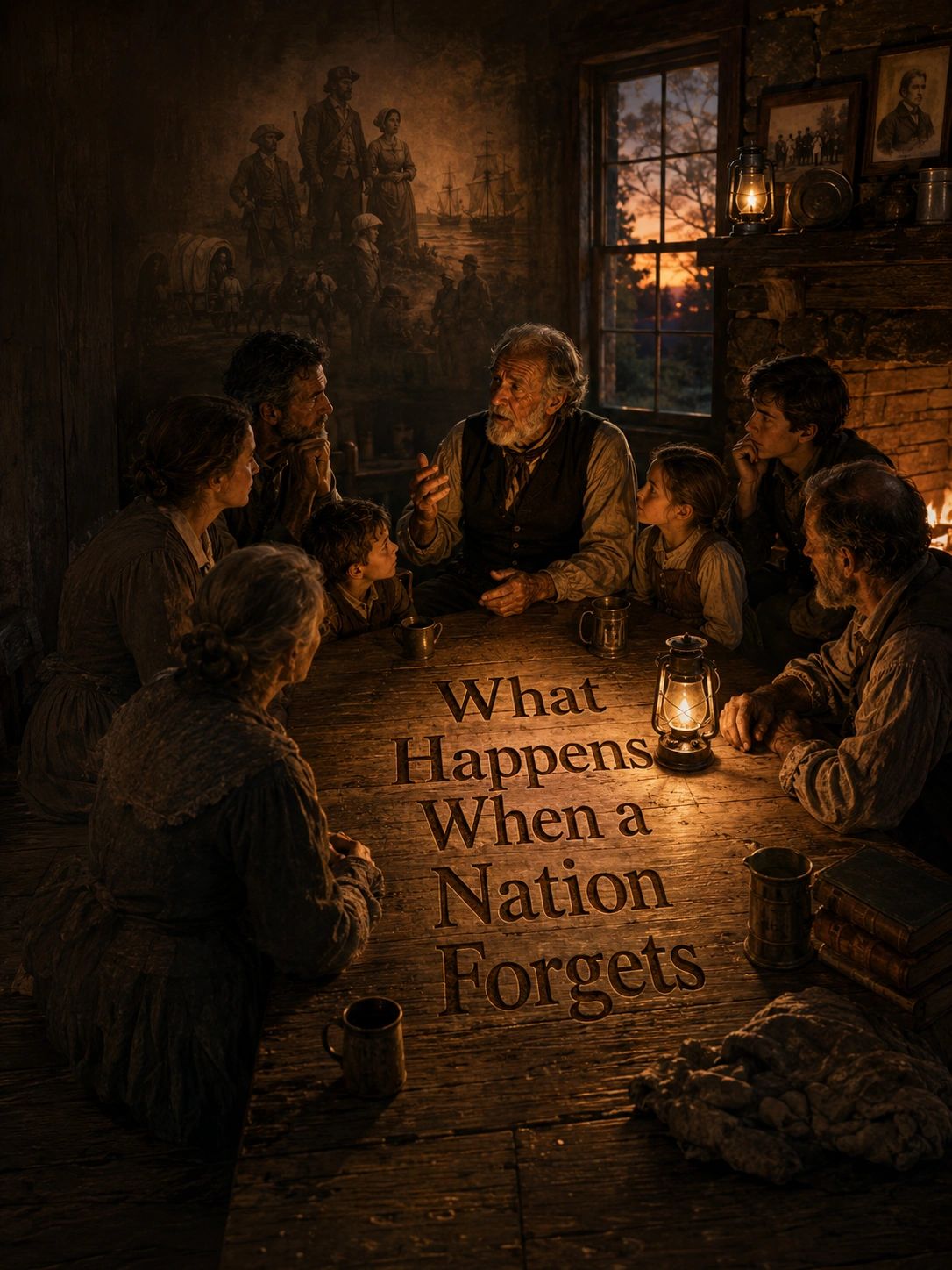
    A nation is not held together by land alone. It is held together by memory.

    Shared memory gives people a sense of where they came from, what was endured before them, what was handed forward, and what responsibilities still remain. It teaches a people that they are not merely individuals living beside one another in the same moment. They are part of a longer story, connected to generations before them and responsible to generations not yet born.

    When memory is alive, people understand that freedom, comfort, opportunity, and stability did not appear by accident. They see the sacrifice behind the inheritance. They recognize that men and women worked, suffered, built, defended, repaired, and carried hope forward through times they could not fully control.

    That kind of memory creates gratitude.

    And gratitude helps create responsibility.

    The Danger Of Forgetting

    When a nation forgets, it does not simply lose facts. It loses perspective.

    People may still know famous names, familiar dates, and a few major events, but the deeper meaning begins to fade. The sacrifices become distant. The suffering becomes abstract. The courage becomes a slogan. The failures become either ignored or exaggerated until people no longer know how to learn from them honestly.

    Forgetting makes it easier to take comfort for granted. It makes freedom feel automatic. It makes responsibility feel optional. It can make people believe they are separate from the past, separate from one another, and separate from the consequences of what they choose in the present.

    That is dangerous because human beings need roots. Without roots, people become easier to divide, easier to discourage, easier to manipulate, and easier to convince that nothing before them matters.

    A people who forget where they came from may still be busy, informed, entertained, and opinionated.

    But they may not be wise.

    When Stories Stop Being Passed Down

    For much of human history, memory was carried through stories.

    Grandparents told children what life had been like. Parents explained what had been endured. Communities remembered wars, migrations, hardships, losses, achievements, mistakes, and blessings. Stories were not only entertainment. They were how values traveled from one generation to the next.

    A child learned who they were by hearing who came before them.

    They learned that life had not always been easy. They learned that people survived hard seasons. They learned that families had carried burdens, crossed oceans, worked land, buried loved ones, fought wars, endured poverty, built homes, served neighbors, and kept going when giving up might have seemed easier.

    When those stories stop being passed down, something important breaks. Children may still grow up surrounded by information, but they may not receive belonging. They may know how to search for answers, but not understand the long human chain that brought them into the world.

    That loss matters.

    Because a person who does not know they are part of a story may struggle to understand why their own choices matter.

    Forgetting Weakens Responsibility

    Memory teaches responsibility because it shows that every generation receives something it did not create by itself.

    None of us built the entire road beneath our feet. None of us invented every freedom we enjoy. None of us paid every cost required to make our lives possible. We inherit language, law, family, community, knowledge, sacrifice, warning, wisdom, and opportunity from people who lived before us.

    That inheritance does not make us better than others.

    It makes us responsible.

    When a nation forgets this, people begin to live as if the present belongs only to them. They may consume what others built without asking what should be preserved, repaired, improved, or handed forward. They may criticize the past without learning from it, or praise the past without telling the truth about it.

    Both are forms of forgetting.

    REMEMBRANCE asks for something harder and more useful: honest memory. Not worship. Not hatred. Not nostalgia. Honest memory.

    The kind of memory that says: human beings before us were imperfect, but many carried burdens for our sake. Some built wisely. Some failed terribly. Some sacrificed greatly. Some caused deep harm. All of it must be remembered if we are going to inherit the past with wisdom instead of confusion.

    A Nation Can Remember Again

    Forgetting is dangerous, but it does not have to be permanent.

    A person can remember again. A family can remember again. A community can remember again. A nation can remember again.

    It begins when someone chooses to slow down long enough to ask better questions. Who came before me? What did they endure? What did they build? What did they get wrong? What did they protect? What did they hand forward? What am I responsible for now?

    Those questions can change a life.

    They can make a person more grateful. More patient. More humble. More courageous. More willing to serve. More willing to protect what is good and repair what is broken.

    That is why this journey matters. We are not remembering history so we can live in the past. We are remembering history so we can live more wisely in the present.

    The Story Must Be Carried Forward

    Every generation decides whether memory will continue.

    If one generation stops telling the story, the next generation may inherit comfort without understanding cost. It may inherit freedom without understanding responsibility. It may inherit rights without understanding sacrifice. It may inherit a country without understanding the human beings who carried it this far.

    That is not only a historical problem.

    It is a human problem.

    Because people who forget too deeply can lose sight of one another. They can stop seeing neighbors as fellow human beings. They can stop recognizing the dignity of those who disagree with them. They can become loud without becoming wise, connected without becoming compassionate, and informed without becoming rooted.

    The answer is not to force memory.

    The answer is to make memory alive again.

    To tell the story with enough honesty that it can be trusted. To tell it with enough humanity that it can be felt. To tell it with enough humility that it can teach. To tell it with enough hope that it can still call people forward.

    That is the work of REMEMBRANCE.

    Not simply to preserve old information, but to recover living wisdom.

    Not simply to tell readers what happened, but to help them understand what must not be lost.

    A nation does not remember because the past was perfect.

    A nation remembers because the future needs wisdom.

    And wisdom must be carried forward by someone.

  • Information Is Not Wisdom

    The Sound Of Silence

    I grew up in a world where silence was not empty. It was where you thought. It was where you learned to listen. It was where you figured things out because there was not always someone standing over you, explaining every step, warning you about every mistake, or rescuing you from every consequence.

    When I was young, freedom came early, and so did responsibility.

    We rode minibikes. We stayed outside until the streetlights came on. We learned where the limits were because we found them ourselves. We learned that choices had consequences because life had a way of teaching directly. Nobody had to explain every lesson in advance. Some lessons came from scraped knees, broken parts, lost tools, hard work, and the quiet understanding that you would have to do better next time.

    That kind of learning stays with a person because it is not only stored in the mind. It becomes part of how you see the world.

    There was value in that slower world. Not because it was perfect, and not because every part of it should return, but because it gave people room to become capable. You had time to wonder. You had time to be bored. You had time to make a mistake and think about it. You had time to watch how older people handled problems before you were expected to handle your own.

    Silence gave lessons space to settle.

    Before Everything Had An Answer

    Before technology took over so much of daily life, people had to remember things.

    Phone numbers lived in your head. Directions were learned by landmarks. If you were going somewhere unfamiliar, you paid attention. You remembered the gas station on the corner, the bend in the road, the church steeple, the old oak tree, or the house with the white fence. The world asked more of your memory because there was no screen waiting to do all the remembering for you.

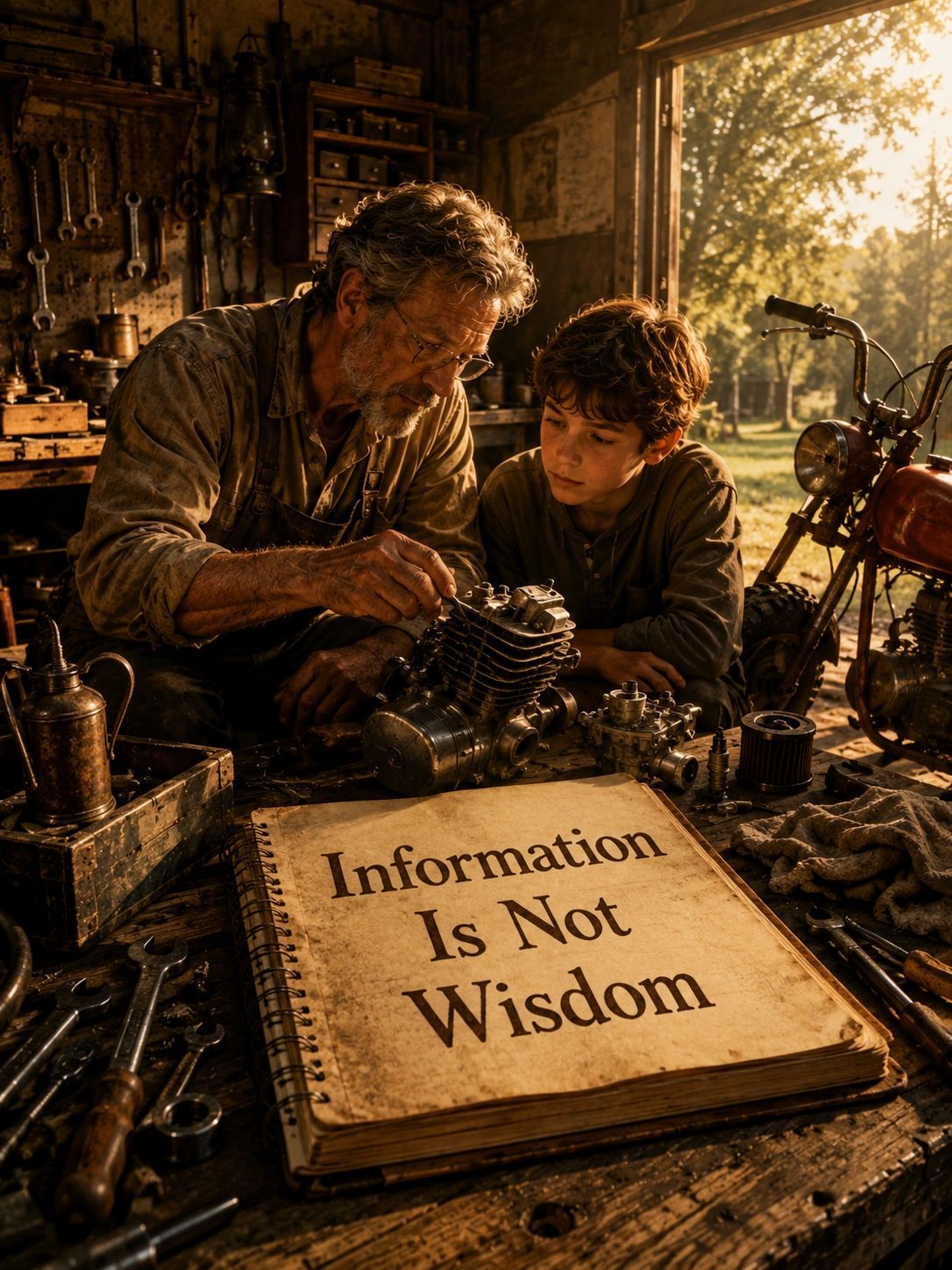
    Conversations happened face to face. If something broke, you tried to fix it. If you did not know how, you watched somebody who did. A father, a neighbor, an uncle, a grandparent, or a friend down the street could teach more in an afternoon than a set of instructions ever could.

    Knowledge moved from person to person, hand to hand, story to story. You learned by watching. You learned by trying. You learned by failing and being told to try again. That was not just information. That was wisdom.

    Wisdom often came wrapped in ordinary moments. It came while holding a flashlight for someone repairing an engine. It came while listening to adults talk around a kitchen table. It came while watching someone keep their word, apologize after being wrong, help a neighbor without being asked, or finish a job even when nobody was watching.

    No one always stopped to announce the lesson. You absorbed it because you were close enough to see it lived.

    The Difference Between Knowing And Understanding

    Information can tell you the answer. Wisdom helps you understand what the answer means.

    Information can be found in seconds, but wisdom usually takes years. Information can tell you how something works. Wisdom teaches you when to speak, when to wait, when to help, when to stand firm, and when to admit you were wrong.

    That is one of the great differences between knowing and understanding.

    The modern world gives us more answers than any generation before us could have imagined, but answers alone do not make people wise. A person can know a thousand facts and still not understand patience, sacrifice, responsibility, gratitude, or courage. A person can search history in seconds and still never feel connected to the people who lived it.

    History used to help connect those things. It connected children to parents and grandparents. It connected families to the sacrifices that came before them. It reminded people that they were not alone in time. They were part of a long human chain, stretching backward through struggle and forward into responsibility.

    When that connection weakens, we risk losing more than old stories. We risk losing self-reliance, patience, community, responsibility, and the ability to understand our own place in the story.

    That is why this chapter matters near the beginning of the journey.

    Before we walk into the old world, the ocean crossing, the colonies, the Revolution, the Civil War, and the generations that followed, we have to understand the difference between collecting facts and receiving meaning. The facts will matter. The dates will matter. The events will matter. But if we never feel the human meaning underneath them, then history stays flat on the page.

    What The Modern World Cannot Replace

    This journey is not about wishing everything could go back to the way it was.

    Every generation has its blessings and its burdens. The past was not perfect, and the present is not hopeless. Technology has given us tools, speed, convenience, and access to knowledge that earlier generations could hardly have imagined.

    But there are still things no machine can hand us fully formed.

    People still need courage. People still need patience. People still need responsibility. People still need each other. Every generation still needs to understand that the world it inherits was built by people who came before.

    That understanding does not come from information alone. It comes from memory, experience, stories, hardship, gratitude, and the willingness to listen to those who have already walked part of the road.

    If younger generations are going to understand where they belong, they need more than facts on a screen. They need to know they are part of something older, deeper, and more meaningful than the moment they are living in. They need to know that people before them struggled, built, failed, repaired, endured, and passed something forward.

    They need to know their lives are not disconnected fragments floating in the present.

    A person who does not know where they came from can be made to feel rootless very easily. A people who forget their story can be pushed around by every loud voice of the moment. But when memory is alive, it gives people a place to stand. It does not make them perfect. It does not give them every answer. But it reminds them that they belong to something larger than themselves, and that they are responsible for more than their own comfort.

    Passing Wisdom Forward

    That is why information is not enough.

    We need memory. We need experience. We need stories. We need wisdom. Not because the past was perfect, but because the past contains human lessons that can help us live with more humility, gratitude, responsibility, and courage.

    The REMEMBRANCE Journey is built on that belief: not merely gathering historical facts, but recovering the meaning inside them. It is a way of slowing down long enough to see the people behind the events, the cost behind the comfort, and the responsibility behind the inheritance.

    If we remember that truth, then maybe we can still pass along something worth carrying. Not just information. Not just opinions. Not just quick answers. Something deeper. Something earned. Something human enough to help the next generation understand where they came from, what was handed to them, and why it still matters.

    And that is where this journey must continue.

    Because when information replaces wisdom, people do not merely forget details. They begin to forget meaning. They begin to forget sacrifice. They begin to forget the human chain that carried them here. And when a people forget long enough, they can lose more than memory. They can lose themselves.