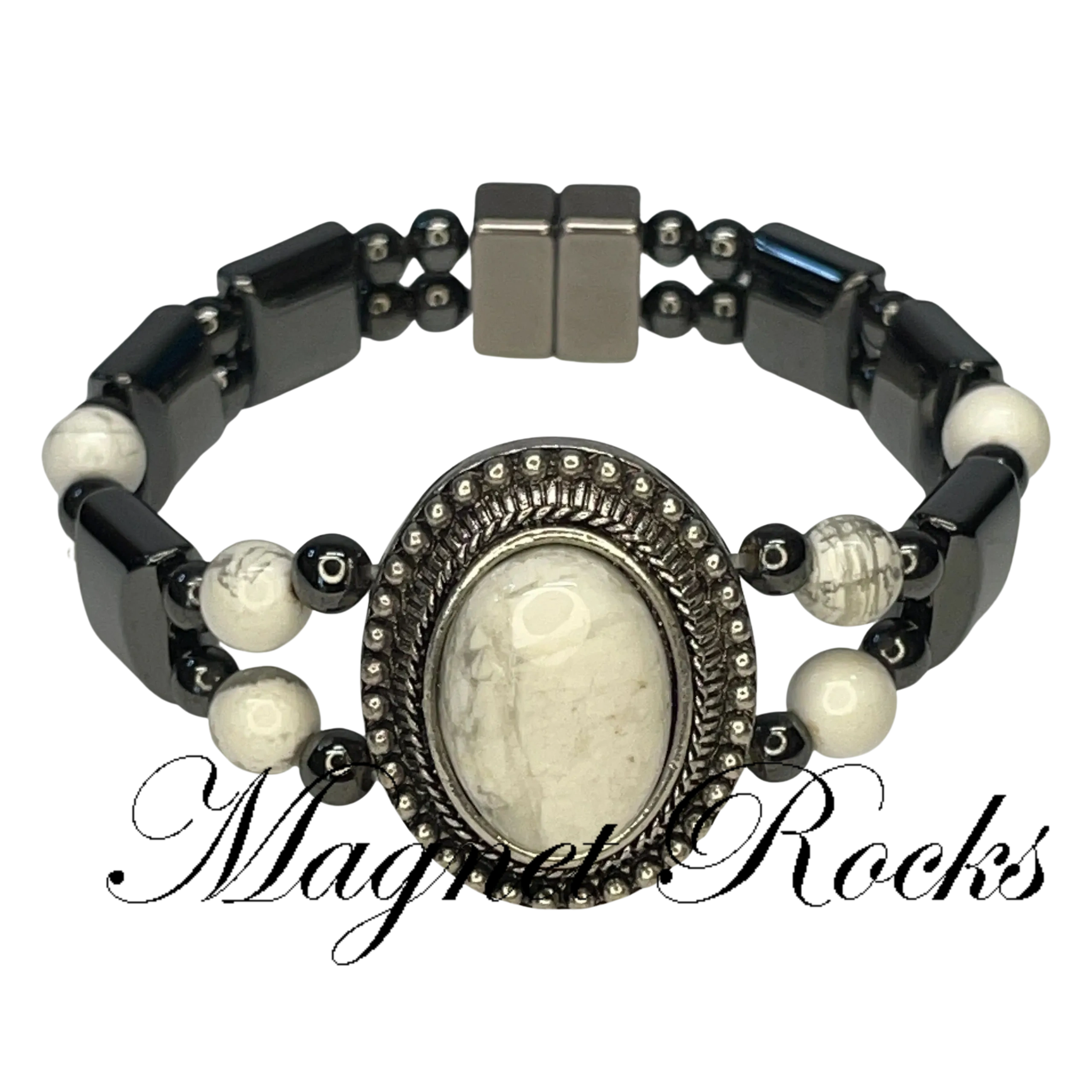
The Discovery and Geological Origin of Howlite
Howlite may be beloved today as a calming white stone, but it was unknown to the world until the late 19th century. In 1868, Canadian chemist and geologist Henry How first discovered howlite near Windsor, Nova Scotia en.wikipedia.org. Local gypsum miners had been encountering an irritating white mineral in their quarry and alerted How to this “nuisance” find en.wikipedia.org. Upon investigation, How recognized it as a new mineral species. He initially named it silico-boro-calcite to reflect its chemical makeup, but shortly afterward American geologist James Dwight Dana rechristened it howlite in honor of its discoverer en.wikipedia.org.
A Unique Borate Mineral
Geologically, howlite is a calcium borosilicate hydroxide, placing it in the borate family of minerals en.wikipedia.org. It typically forms in evaporite deposits, environments where water evaporation leaves behind mineral concentrations en.wikipedia.org. The most common occurrence of howlite is in irregular nodules that often resemble heads of cauliflower in shape en.wikipedia.org. These nodules are chalky white or light gray with fine gray or black veins creating a spiderweb-like pattern across the surface en.wikipedia.org. Fully formed howlite crystals are extremely rare – they have been found only in a couple of locales (notably southern California and Iona, Nova Scotia) and even then reaching just about one centimeter in size en.wikipedia.org. With a modest hardness of around 3.5 on the Mohs scale, howlite is a relatively soft mineral that can be easily scratched or carved.
Early mineralogists classified howlite based on its composition and structure. It crystallizes in the monoclinic system and, unlike many minerals, shows no prominent cleavage planes when broken en.wikipedia.org. In terms of chemical formula, howlite is noted as Ca₂B₅SiO₉(OH)₅ – a makeup that includes calcium, boron, silicon, oxygen, and hydrogen en.wikipedia.org. This complex formula explains why howlite is sometimes found in the company of other boron-rich minerals. In fact, howlite often occurs alongside minerals like gypsum and calcite, sharing the same sedimentary environments geologyin.com.
From Quarry Curiosity to Collector’s Item
After its discovery, howlite slowly gained attention beyond academia. What started as a pesky quarry mineral soon became a collector’s curiosity and an attractive material for artisans. Howlite’s porous texture and interesting veining made it suitable for carving small ornaments and polishing into cabochons. By the early 20th century, lapidarists were carving howlite into beads, cameos, and figurines, appreciating its smooth white marble-like appearance. The stone also proved surprisingly versatile – due to its porous nature, it readily absorbs dyes. This led to howlite being famously used as an imitation turquoise once dyed a vibrant blue, since the natural gray veining can resemble the matrix of turquoise en.wikipedia.org. In its undyed form, howlite has been marketed under names like “white turquoise” or “white buffalo stone” for jewelry, valued for its neutral yet striking look en.wikipedia.org.
Symbolic Meaning and Early Uses
Unlike ancient gems, howlite doesn’t have millennia of lore, but it quickly acquired a reputation in metaphysical circles. Crystal enthusiasts often celebrate howlite as a stone of calm and patience. Its gentle white color with gray veins is said to symbolize patience and perspective in crystal lore tinyrituals.co, helping people tap into a more mindful, centered state. Early adopters of howlite in spiritual practices found that holding or wearing the stone seemed to soothe tension and quiet the mind geologyin.com. Over time, howlite became known as a “calming stone” – a crystal ally for reducing stress and anger. Some even nicknamed it the “attunement stone,” believing it helps attune the user to higher spiritual vibrations and deeper self-awareness.
Today, the legacy of Henry How’s 1868 discovery lives on each time someone picks up a piece of howlite for its calming energy or admires its milky white beauty. A mineral that once annoyed miners has transformed into a cherished gemstone with both scientific significance and a gentle, symbolic role in modern healing practices. As a Daytona Beach shop rooted in crystal wellness, we invite you to explore Magnet Rocks’ collection of howlite jewelry or stop by to learn more about this unique stone’s benefits. Stay tuned for Day 2 of our Howlite series, where we’ll explore howlite as a gemstone in jewelry and its calming benefits in style!
Sources
- Wikipedia – “Howlite”en.wikipedia.org en.wikipedia.org en.wikipedia.org en.wikipedia.org en.wikipedia.org
- Tiny Rituals – “Howlite Crystal Meaning: Healing Properties & Everyday Uses”tinyrituals.co
- Geology In – “Howlite: Meaning, Properties, Uses”geologyin.com geologyin.com
Magnet Rocks – Hematite Magnetic Jewelry | Daytona Beach, FL – Since 2012